Country action

Country action

© UNICEF/Onafuwa.
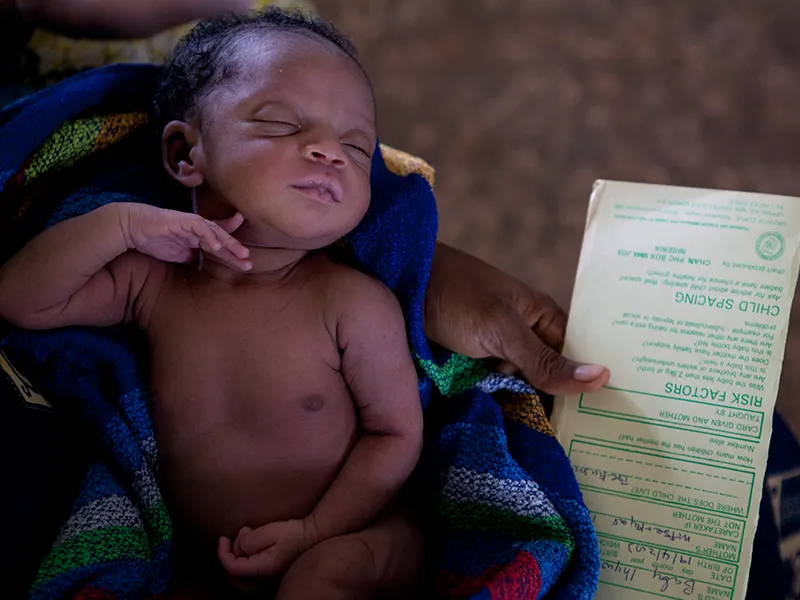
A portrait of Ngozi Nwabunwannem and her baby, Goodluck at Otuocha Primary Healthcare Center, Anambra State, Nigeria, in June 2023.

Every Woman Every Newborn in Nigeria

Download the full profile with additional key demographics, progress against milestones, and more.

This profile was developed in November 2024, using data from 2021-2024. 

© UNICEF/Esiebo. A woman holds her infant at Father Matthias Health Care Centre in the town of Naka, in Gwer West, Benue State in April 2013.

MNH Acceleration Plan highlights

In 2026, Nigeria’s MNH Acceleration Plan prioritizes the following:  

  • Recruit, deploy equitably, train and retain qualified health workers; provide  pre-service and onsite training, implement the national health workforce retention strategy  and the community-based health care workers strategy at scale.

  • Increase the availability of quality maternal and newborn health commodities and equipment with pool procurement and last mile distribution, and by strengthening local manufacturing.
  • Strengthen the integration of maternal and newborn services with other programmes, such as non communicable diseases.
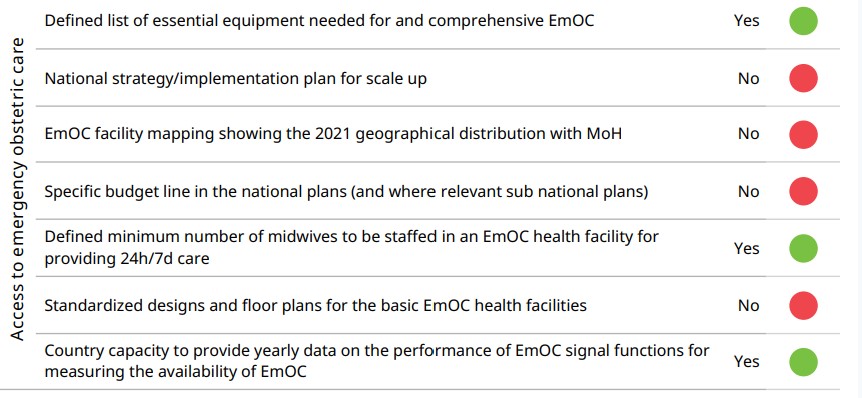
  • Scale up emergency obstetric and newborn care and referral pathways.
  • Increase data digitalization and the interoperability of data platforms.
  • Increase domestic funding: pool resources at subnational level, expand the health insurance benefit package to include additional maternal and newborn health interventions and community-based insurance.

©UNICEF/Esiebo.
In April 2013 in Nigeria, Pregnant women wait to receive antenatal care at Gre West Government General Hospital in the town of Naka, in Gwer West, Benue State, Nigeria, in April 2013.

National mortality targets

Maternal
mortality ratio

140 per 100,000 live births
by 2030

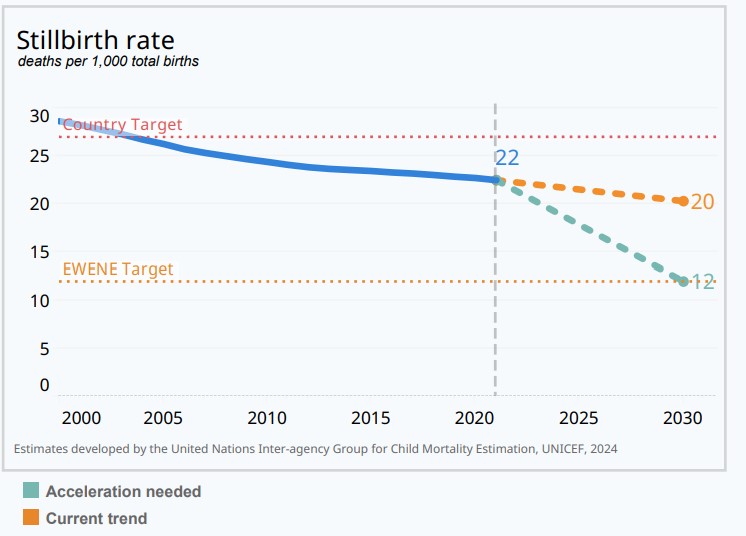
Stillbirth
rate

10 per 1,000 total births
by 2030

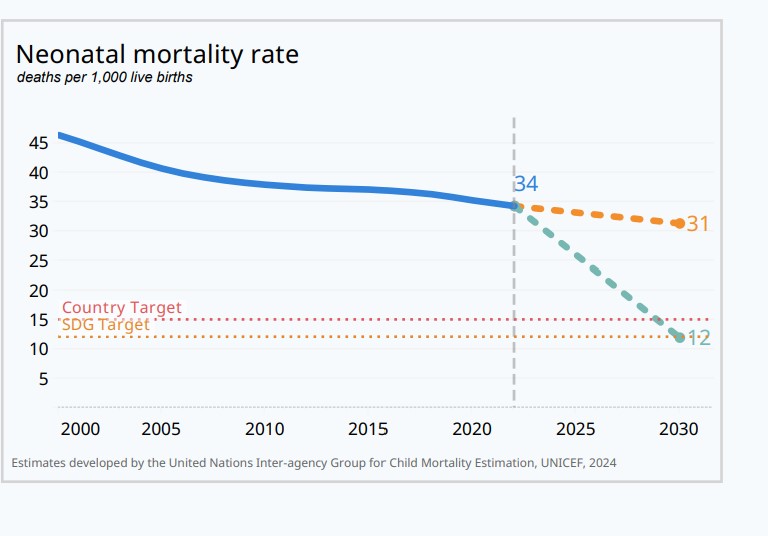
Neonatal mortality rate

15 per 1,000 live births
by 2030

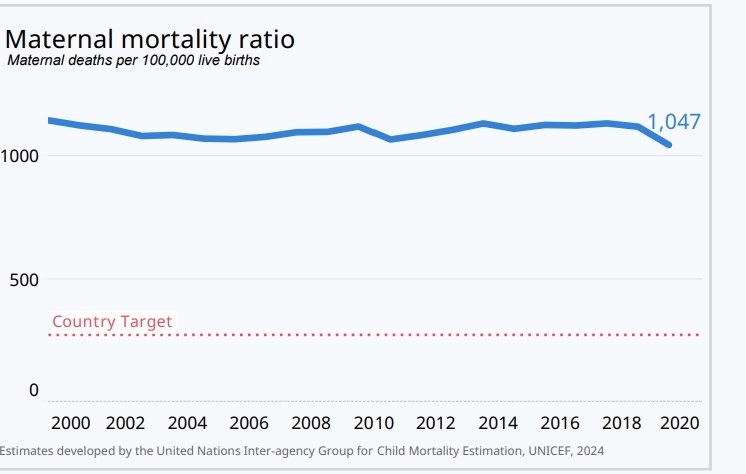
Progress to meet the national maternal, newborn mortality and stillbirth reduction targets

© UNICEF/Onafuwa. Aisha Tukur Isyaku, the Executive Secretary of the Kaduna State Health Supplies Management Agency takes a tour of the agency warehouse in Kaduna, Nigeria in June 2023.

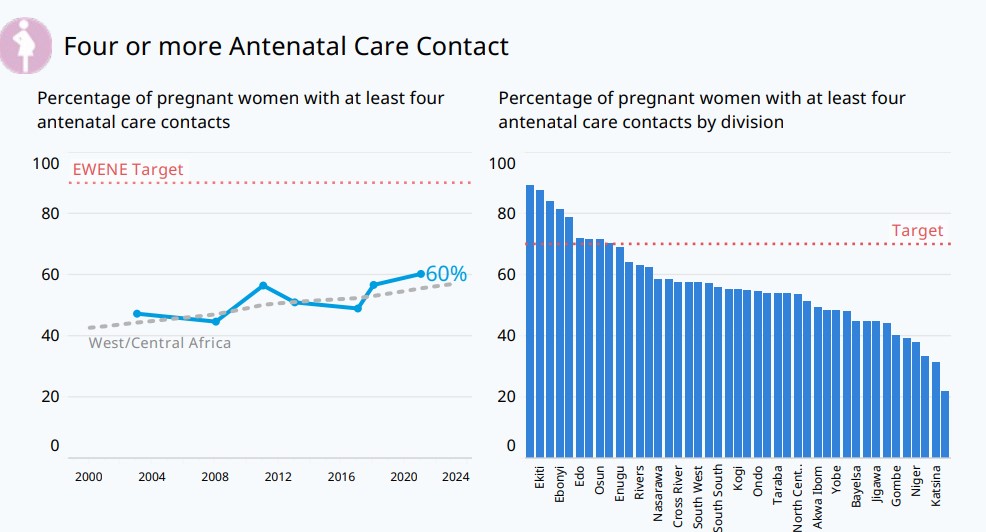
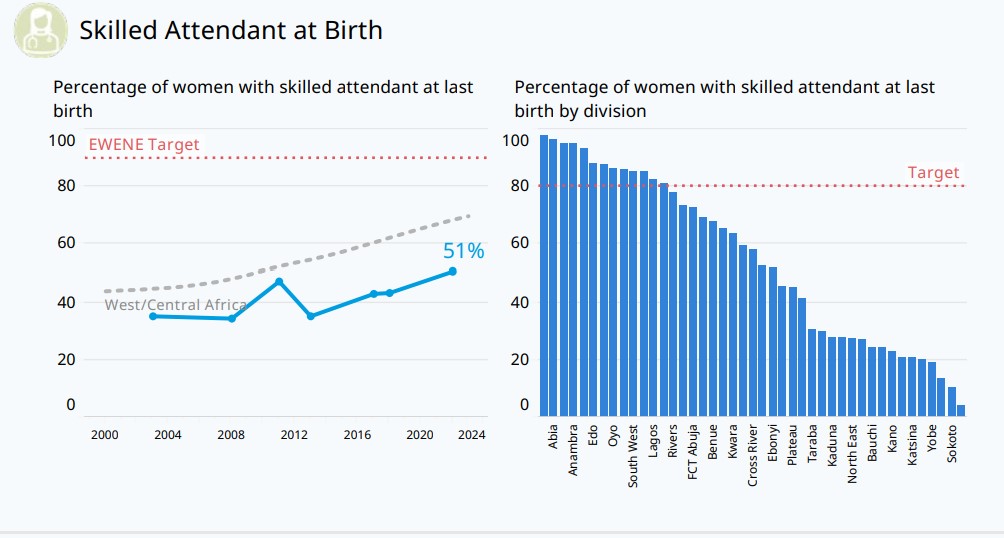
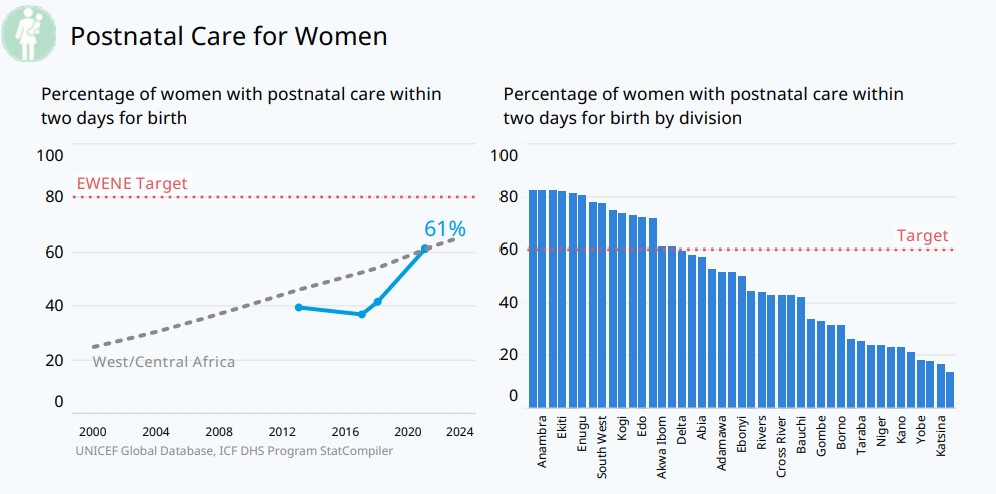
Progress to meet Every Woman Every Newborn Everywhere coverage targets

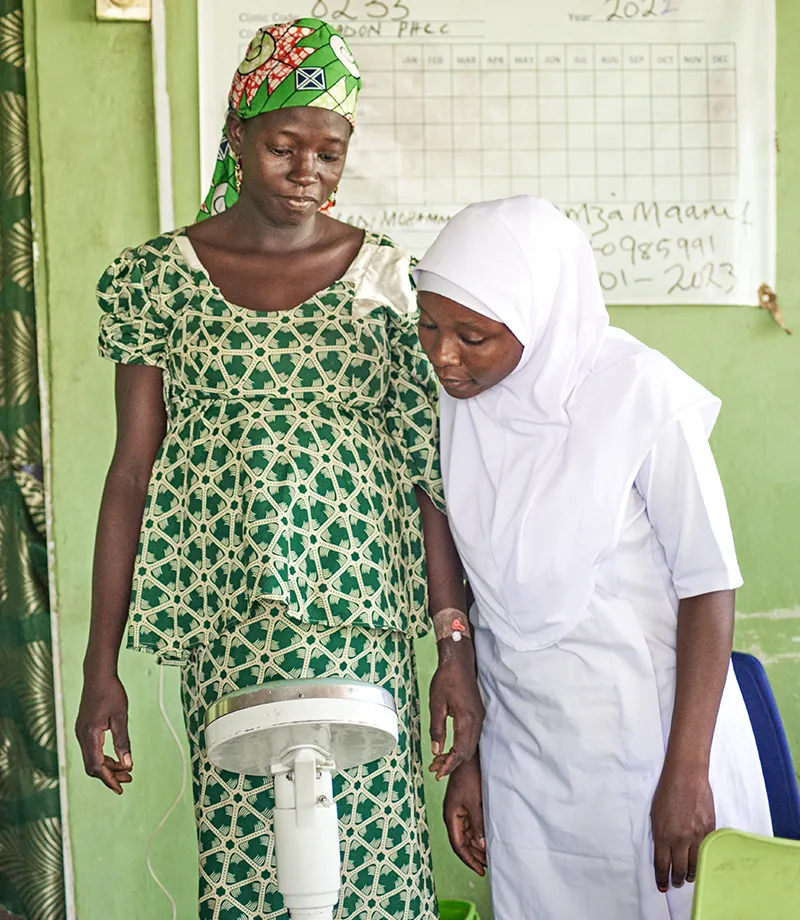
© UNICEF/Boman Rayanattu Adamamu, a midwife at Kwando primqry health care centre attends to a patient in November 2023.

Quality of care in Nigeria

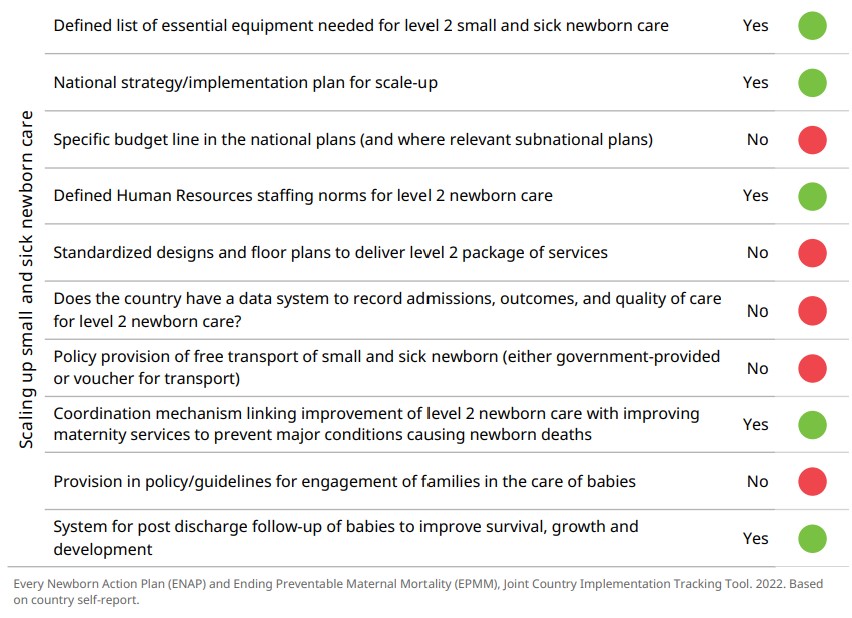
Nigeria is one of the 11 countries that set-up the Network for Improving Quality of Care for Maternal, Newborn and Child Health (Quality of Care Network). Nigeria’s successes in improving quality of care for maternal, newborn and child health are essential to help reduce maternal and newborn mortality and stillbirths. These include:

  • The National Strategy on quality of care for maternal and newborn health  was developed and deployed, and a technical working group established to coordinate the quality of care activities at national level. Thanks to a similar structure at state level, the number of quality of care learning sites grew from 112 in 12 states to 208 in 24 states by end of 2022.
  • The World Health Organization’s standards to improve quality of maternal and newborn care, small and sick newborns care, and children and young adolescents care in health facilities are adopted.
  • The 62nd National council on health resolved to scale up quality of care implementation and this has drastically added a large number of sites called scale up sites which kept increasing by the day.
  • The National Quality of Care Learning Platform was deployed, providing information and updates on quality of care activities around the country.  The platform provides information for peer-to-peer learning and knowledge exchange among parties who support quality of care for reproductive, maternal, newborn, adolescent and elderly health plus nutrition (RMNCAEH+N)
  • A national maternal and perinatal death sruveillance and response MPDSR bill passed by Parliament provides a protective legal environment for MPDSR to safeguard its “no name, no blame” ethos and the confidentiality of information, without impeding the rights of deceased’s families to seek legal redress.

News and events

Lessons to end postpartum hemorrhage

First webinar in a four-part series sharing lessons from the Accelerating Measurable Progress and Leveraging Investments for Postpartum Hemorrhage Impact (AMPLI-PPHI) project. Organized by Jhpiego.

Read more

Resources

See also: ‘Ensuring Lifesaving MNH Commodities for Every Woman and Newborn in Nigeria‘, the poster that the Nigeria delegation presented at the International Maternal Newborn Health Conference 2026. 

Key Messages on Women’s,Children’s and Adolescents’ Health

For the Seventy-ninth World Health Assembly

These messages were developed by the United Advocacy Working Group for Maternal, Newborn and Child health.
International Maternal Newborn Health Conference 2026: country posters

Posters presented by 40 country delegations at the International Maternal Newborn Health Conference 2026.

Unified Advocacy Asks for Maternal and Newborn Health

International Maternal Newborn Health
Conference (IMNHC) 2026

These key messages and advocacy asks are intended to equip partners with evidence-based messaging and
resources in the context of IMNHC 2026.